
Home / Services / Wheel alignment
Wheel alignment · Tyler & Longview
Wheel alignment in Tyler, TX
and Longview, TX.
Camber, caster and toe set to the manufacturer's spec at both shops: Tyler on SE Loop 323 and Longview on Spur 63. Some folks call it a tire alignment; it is the same job. Every lift and leveling kit we install gets aligned afterwards, and any set of tires lasts longer when the geometry is right. We measure first, then quote straight.
What gets set
Three angles.
One straight truck.
An alignment does not touch the tires or the wheels. It adjusts the angles the suspension holds them at, so all four roll straight, sit flat on the road and wear evenly. When those angles drift, the vehicle pulls, the steering wheel sits crooked and the tread goes early on one edge.
When to come in
Uneven wear is the expensive symptom. A tire that has been dragged sideways for a few thousand miles cannot be saved by an alignment; it can only stop the next set going the same way.
Camber
The inward or outward tilt of the tire seen from the front. Off, and one edge of the tread carries the load.
Caster
The forward or backward tilt of the steering axis. It decides how straight the vehicle tracks and how the steering wheel returns to center after a turn.
Toe
Whether the tires point slightly in or out seen from above. The biggest tire-wear angle, and the first one a curb hit knocks out.
Steering & suspension check
Worn tie rods, ball joints or bushings will not hold an alignment. We look before we set, and tell you if a part needs to come first.

Lifted or leveled
Raise it,
then align it.
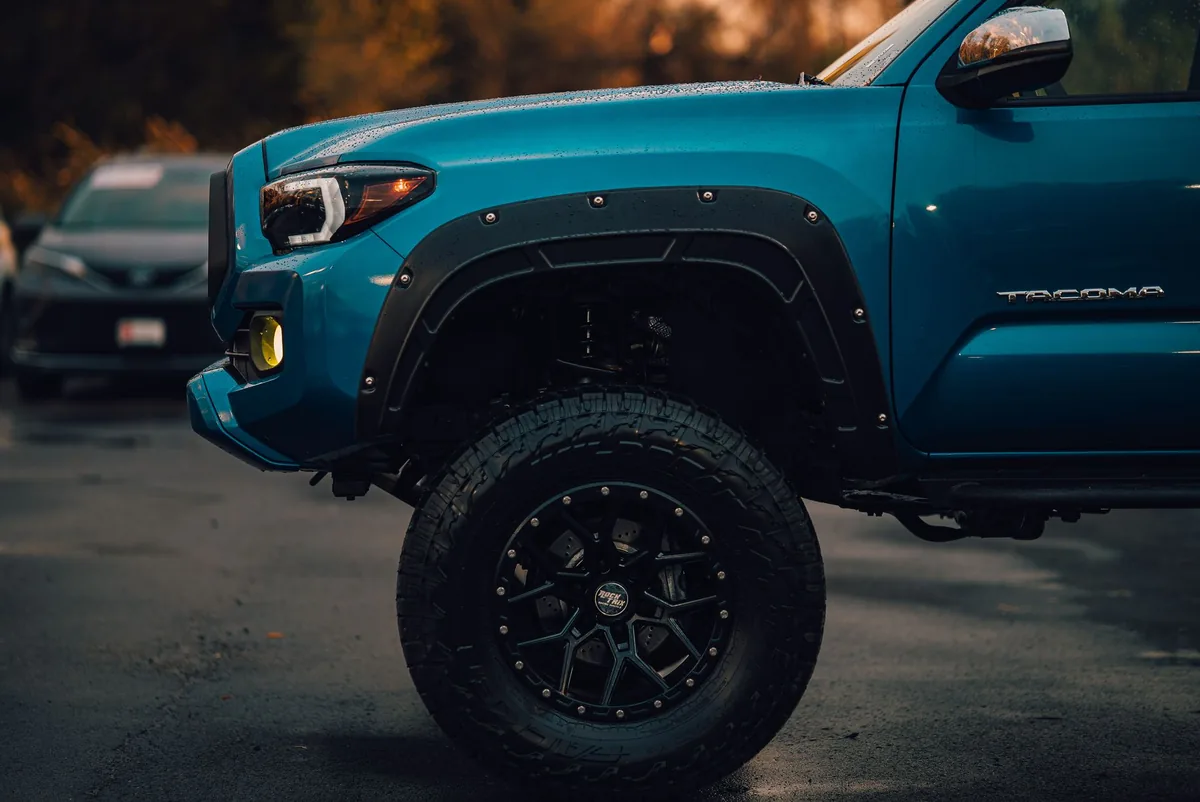
Raising a truck moves its suspension geometry: camber, caster and toe all change with the ride height. Skip the alignment and the truck will eat the edges off expensive tires. That is why every Rough Country lift and leveling kit we install in Tyler and Longview is aligned after the height change, not left for later.
Where to bring it
Two shops.
Same alignment standard.
Alignment in Tyler, TX
2019 S. SE Loop 323, Tyler, TX 75701. Open Monday to Friday 8 to 7 and Saturday 9 to 6, closed Sunday. Walk-ins are welcome during posted hours, and every lift and leveling kit installed here is aligned before it leaves. Call (903) 500-8557 to confirm a service time before you drive over. Tyler shop details.
Alignment in Longview, TX
100 S Spur 63, Longview, TX 75601. Open Monday to Saturday 8 to 6:30 and Sunday 11 to 3. Walk-ins are welcome seven days a week during posted hours; call (903) 500-9626 to confirm availability for your vehicle before you travel. Longview shop details.
Pick whichever shop is closer. Both shops set the angles to the same manufacturer spec, within the adjustment each vehicle allows, and a quote request does not reserve a bay at either.
Read the tire
The tread
tells on the angles.
Cupping, feathering or one worn edge usually points at balance, alignment or suspension rather than the tire itself. We check all three before we recommend anything, because a new set on a crooked truck wears out the same way the old one did.
Parts first. Then the angles.
An alignment rack cannot tighten a loose tie rod or take the play out of a worn ball joint. Both shops do the steering and suspension repair as well as the alignment, so a worn part gets replaced under the same roof before the angles are set, and we tell you before anything gets adjusted. The usual times on our services page are roughly 30 minutes for a suspension inspection, 60 for tie rods and 120 for ball joints, shocks or struts. Fix the part first, then set the angles.
One edge worn
Usually camber. The tire has been leaning on one shoulder.
Feathered tread
Usually toe. The blocks are scuffed on one side from being dragged.
Cupping or scallops
Usually balance or worn shocks, not alignment. We check those first.
Suspension repair
Tie rods, ball joints, shocks and struts, checked before the angles are set.
Alignment questions
Alignment questions,
straight answers.
What is the difference between wheel alignment and wheel balancing?
How do I know if my vehicle needs an alignment?
Do I need an alignment after a lift or leveling kit?
Should I get an alignment when I buy new tires?
Do both Wheels Up Front shops do alignments?
What does an alignment cost in Tyler or Longview?
Can I get an alignment on a Sunday?
Not sure it is the alignment?
Describe it.
We'll find it.
Tell us what the vehicle is doing: the pull, the vibration, where the wear is. We measure the angles, look over the suspension and tell you which one it is before anything gets adjusted.
Check the Tyler shop details for the SE Loop location, or the Longview shop details for Spur 63. Confirm service availability with that shop before you travel.